
In the catering industry, commercial soup cookers are one of the most important equipment that…
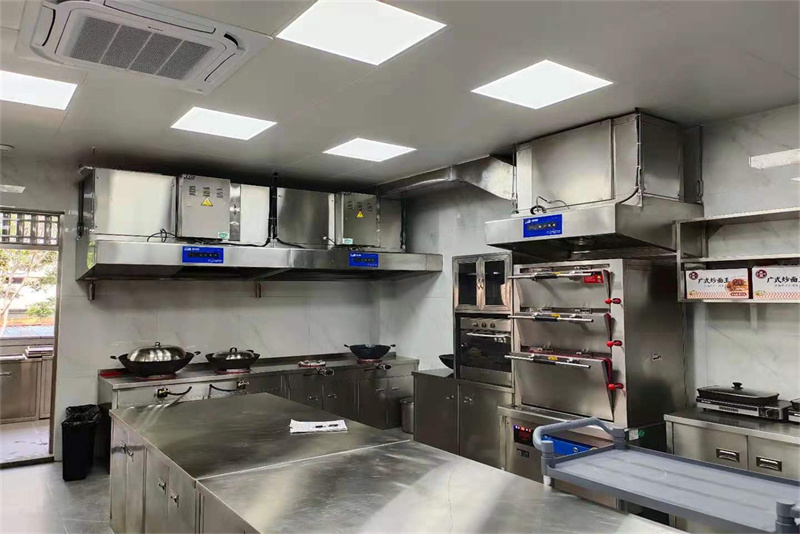
Why Chain Restaurants and Central Kitchens Are Upgrading to Heavy-Duty Induction Stockpot Stoves
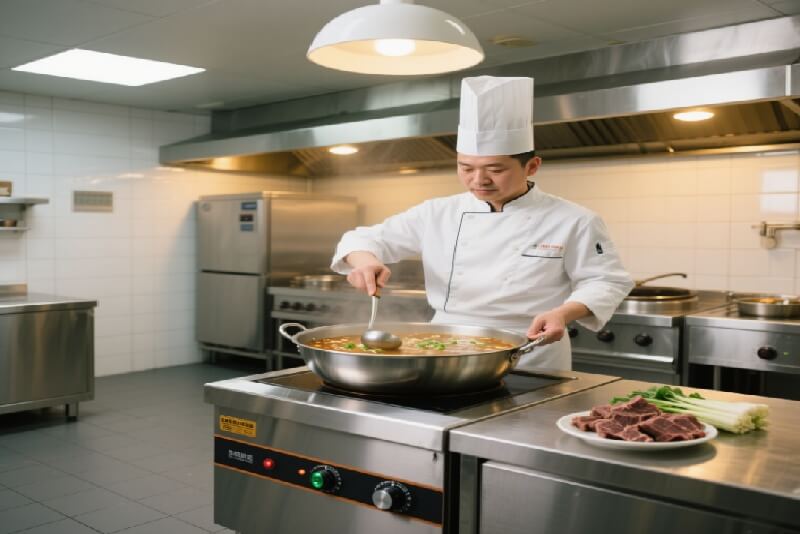
For Marcus Lin, Director of Operations at Northern Noodle House Group—a fast-growing chain with 28 locations known for its rich, collagen-infused bone broth—the most dangerous shift in the kitchen was the one where nobody was working.
Every night at 10:00 PM, after the last dining room guest departed and the kitchen crew clocked out, 300-liter gas stockpot stoves (often known as gas burner ring stoves or “dwarf stoves”) were turned down to a low simmer.
For 12 continuous hours overnight, these open flames burned unsupervised to extract gelatin, marrow, and flavor from hundreds of kilograms of beef and pork bones.
| THE OVERNIGHT GAS STOCKPOT CRISIS | |
| SAFETY HAZARDS Gas flameouts trigger leaks, CO risks, and catastrophic duct fires. | RESOURCE WASTAGE: 30% thermal efficiency wastes thousands of dollars in gas. |
| SCORCHING & BAD YIELD: Concentrated bottom heat scorches broths, ruining overnight batches. | KITCHEN THERMAL SHOCK: Radiant waste heat forces AC chillers to run continuously. |
The operational liabilities of this traditional setup were severe:
Overnight Safety and Fire Liabilities
A sudden pressure surge or air draft could extinguish a low gas flame, leading to silent unburnt gas accumulation. Conversely, a boiling broth overflow could clog burner ports, causing incomplete combustion, dangerously high carbon monoxide (CO) levels, or severe gas fire hazards.
Thermal Inefficiency and High Gas Overhead
Open-flame gas ring stoves operate at a dismal 30% – 35% thermal efficiency. Over 65% of the energy generated by burning gas escapes into the kitchen environment as waste heat, driving kitchen ambient temperatures above 40℃ (104℉) and forcing HVAC chillers to work overtime.
Severe Bottom Scorching and Batch Destruction
Gas burners apply intense direct heat onto a concentrated area at the base of the stockpot. Without continuous manual stirring, heavy sediments, bone particles, and starches sink to the bottom and burn. A single burnt batch destroyed up to 250 liters of broth, representing hundreds of dollars in raw ingredients and lost prep time.
Structural Failure under Heavy Loads
Standard commercial gas burner frames are not built for extreme loads. Dropping 200 — 300kg stockpots filled with liquid and bones onto cast-iron grates caused structural sagging, uneven pot resting, and eventual weld cracks.
Marcus needed a heavy-duty solution that eliminated open-flame hazards, maintained rock-solid temperature control without stirring or scorching, slashed energy costs, and withstood relentless heavy-load abuse.
The answer lay in replacing gas burners with Industrial-Grade Heavy-Duty Commercial Induction Stockpot Stoves.
| Raw Ingredients: 200L Broth + Bones | |
| 1. Heavy-Duty Reinforced Frame (500kg+) | ──► Absorbs Drop Impact |
| 2. Concentric Multi-Ring Induction Coil | ──► Direct 90%+ Uniform Heat |
| 3. Sub-Surface RTD Micro-Temperature | Prevents Overshoot & Scorching |
| 4. Unattended Timer & Safety Auto-Off | ──► Safe 24/7 Unsupervised Simmering |
| Perfect Broth: Zero Scorching & Zero Flame Hazard | |
1. Technical Architecture: The Science of Heavy-Duty Induction Stockpot Stoves
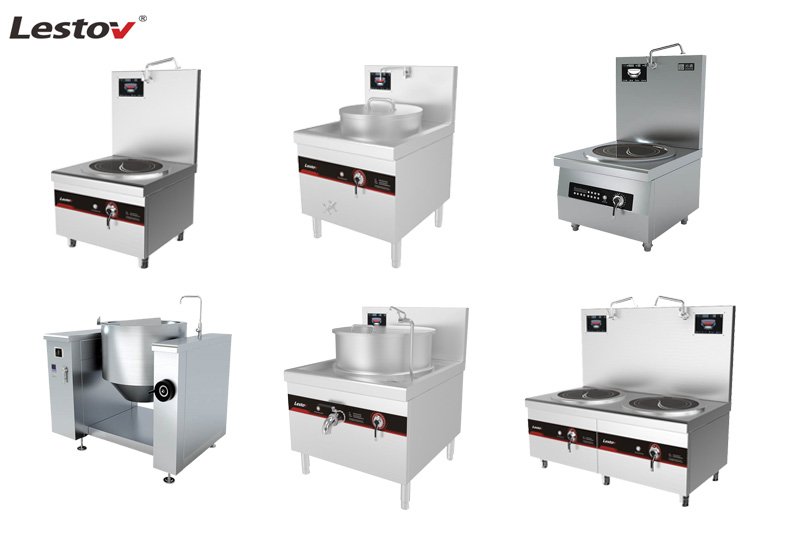
Unlike standard tabletop induction cooktops designed for light pans, a commercial heavy-duty induction stockpot stove is engineered specifically to handle immense weight, deep pot geometry, and continuous multi-day operation.
| Heavy Stockpot Assembly: 300L Liquid + Ingredients | |
| Heavy-Duty Microcrystalline Glass / Ceramic Top | <– 6mm–8mm Shatterproof Glass |
| Multi-Ring Concentric Pure Copper Induction Coil | <– Multi-Zone Magnetic Field |
| Ultra-Fast Sub-Surface Contact RTD Sensor | <– Precise ±1°C Feedback |
| Fully Welded 304 Stainless Steel Reinforced Chassis (500kg+) | <– Heavy Load Frame |
(1)Concentric Multi-Zone Magnetic Induction Coils
Rather than relying on a single flat copper coil, heavy-duty stockpot stoves utilize a multi-ring concentric copper coil array matched to the wide base of stockpots (40- 70 cm diameter).
High-frequency alternating current (20-40kHz) creates a high-density magnetic field that penetrates the ferromagnetic bottom of the stockpot. Heat is generated directly within the vessel base, achieving a thermal efficiency rate exceeding 90%.
(2)High-Impact Microcrystalline Ceramic Tops
The cooking surface consists of a specialized, high-density microcrystalline ceramic panel (6- 8 mm thickness) rated for extreme thermal shock (>800℃) and mechanical impact.
The ceramic panel is supported by a reinforced internal steel cross-member subframe capable of bearing static loads of over 500kg without cracking or flexing.
(3)Precise Thermal Sensor Feedback
A high-sensitivity Resistance Temperature Detector (RTD) sensor is spring-loaded against the underside of the ceramic plate, directly contacting the base of the stockpot. The microcontroller samples vessel temperatures continuously.
When maintaining a slow simmer (85-95℃), power output automatically modulates within ±1℃, keeping broths below a rolling boil to prevent clouding while avoiding bottom scorch.
2. Performance Matrix: Gas Ring Stoves vs. Standard Induction vs. Heavy-Duty Induction Stockpot Stoves
Evaluating commercial soup and broth cooking equipment requires analyzing long-term operational durability, energy efficiency, and safety compliance:
| Metric / Dimension | Traditional Gas Ring Stove (“Dwarf Stove”) | Standard Light-Duty Induction Cooktop | Heavy-Duty Commercial Induction Stockpot Stove | Operational & Financial Advantage |
| Thermal Efficiency | 30%-35% (Massive heat loss) | 85%-88% | 90%+ | Direct magnetic heating cuts energy usage in half. |
| Maximum Load Capacity | 100- 150 kg (Risk of frame sag) | 30- 50 kg (Glass shatter risk) | 500 kg+ (Reinforced 304 chassis) | Safely supports 200L-300L stockpots filled with bones and liquid. |
| Simmering Control & Precision | Manual valve adjustment (Unstable) | Basic power levels (No temp lock) | Microprocessor RTD Feedback (±1℃) | Prevents boiling over, clouding, or scorching delicate stocks. |
| Overnight 24/7 Safety Level | High Hazard (Gas leaks, flameouts, CO) | Moderate (Overheat cutout only) | Maximum Safety (Auto-shutoff, dry-burn cut, no flame) | Enables safe, unsupervised night simmering; reduces insurance premiums. |
| Heat Up Speed (200L Water 20→90℃) | 65-80 minutes | Not Applicable (Pot too large) | 25-30 minutes | Cuts pre-boil time by over 50%, expanding daily prep capacity. |
| Kitchen Ambient Heat Impact | Severe (>42℃ waste heat) | Minimal | Minimal (Stays cool to the touch) | Lowers kitchen HVAC cooling loads significantly. |
| Equipment Life Expectancy | 1.5-3 years (Corrosion from spills) | 1-2 years (Component burn) | 6-10years (IPX6 sealed housing) | Engineered for relentless commercial kitchen duty cycles. |
3. Financial Economics: TCO and ROI Calculation
Upgrading to an industrial heavy-duty induction stockpot stove delivers measurable financial returns through reduced utility costs, zero ruined batches, and lower HVAC cooling requirements.
Daily Shift Operating Cost Comparison (200L Broth Batch / 14-Hour Operation)
Legacy Gas Ring Stove: $28.50/day
Heavy-Duty Induction Stockpot Stove: $10.80/day [62.1% Utility Reduction]
Financial Audit: Chain Restaurant Operation (200L Daily Broth Production)
Consider a commercial kitchen operating a 20kW gas stockpot burner vs. an 18 kW heavy-duty commercial induction stockpot stove running 14 hours per day (2-hour boil + 12-hour simmer):
(1)Energy Cost Audit
Gas Stove Operation: Consumes approximately 2.8 m³ of natural gas per hour during high boil and 1.1m³/hr during simmer. At $0.85/m³, daily gas cost equals 15.98/day.
Induction Stockpot Stove Operation: Consumes 18kW for 0.5 hours (boil) and 3.5kW average draw for 13.5 hours (simmer), totaling 56.25kWh/day. At a commercial rate of $0.16/kWh, daily electrical cost equals $9.00/day (Saving $6.98/day).
(2)HVAC & Kitchen Climate Control Savings
Eliminating 65% of waste heat reduces the load on kitchen air conditioning units, yielding an estimated additional $4.50/day in utility savings.
(3)Waste Prevention & Raw Material Yield
Preventing scorched stockpot bases saves an average of 1 burned batch every two months. At a raw ingredient cost of $280 per 200L batch of marrow bones and aromatics, this saves $4.66/day.
Total Daily Operational Savings = $6.98(Energy) + $4.50 (HVAC}) + $4.66 (Yield) = $16.14USD / day
Annual Operational Savings (365 Days Operation)} = $16.14 * 365 = $5,891.10USD
With an equipment investment of roughly $ 3,200- $ 4,500 USD for a heavy-duty 15-18kW commercial induction stockpot stove, the payback period (ROI) is achieved in under 8 to 10 months.
4. Food Safety, Safety Compliance, and Maintenance Standards
Operating large stockpot equipment requires strict adherence to institutional safety protocols, ergonomic standards, and HACCP compliance.
| SAFETY & HYGIENE COMPLIANCE FEATURES | |
| UNATTENDED AUTO-SHUTOFF: Built-in dry-burn detection cuts power if broth boils away. | IPX6 WASHDOWN SEALING: Fully welded 304 chassis allows direct water spray cleaning. |
| LOW-PROFILE ERGONOMIC HEIGHT Low chassis height reduces lift strain when loading heavy pots. | HACCP TEMPERATURE LOCK: Digital control locks simmer temperature above the danger zone (>63°C). |
(1)Advanced Unattended Safety Safeguards
Dry-Burn Protection
If a stockpot boils dry overnight, the sub-surface RTD sensor detects a rapid temperature spike above 230℃ and cuts power within milliseconds, preventing pot destruction and fire hazards.
Auto Power Cutoff: Built-in programmable 24-hour digital timers allow operators to set exact simmer times, automatically switching to a warm-holding mode when completed.
(2)Low-Profile Ergonomic Frame Design
Standard stockpot stoves are built with a low chassis height (40- 50 cm off the floor). This low center of gravity allows kitchen operators to slide heavy 200L stockpots onto the stove surface without dangerous high lifting, mitigating lower-back injuries and accidental hot liquid spills.
(3)IPX6 Waterproof Construction & Easy Cleaning
Stockpot preparation involves frequent boil-overs and heavy washdowns. Heavy-duty induction stockpot stoves feature a fully sealed IPX6 stainless steel enclosure with seamless welds.
Kitchen staff can clean the stove using standard spray hoses and degreasers without risking electrical shorts or damage to internal IGBT inverter boards.
5. Operational Transformation: Northern Noodle House Group
For Marcus Lin and Northern Noodle House Group, replacing legacy gas ring stoves across their 28 outlets with 18kW Heavy-Duty Commercial Induction Stockpot Stoves reshaped their central operations:
Zero Overnight Incidents
Overnight broth simmer operations ran safely with zero fire alarm triggers, gas leak scares, or flameouts over 24 months.
Flawless Broth Quality
Consistency across all 28 locations reached an all-time high. Bone marrow broths maintained a clear, rich texture without scorching or souring.
Dramatic Utility Reduction
Annual gas and electric utility savings exceeded $ 160,000 USD across the entire chain.
Cooler Working Environment
Kitchen ambient temperatures dropped from 41℃ to a comfortable 24℃, boosting staff morale and reducing summer prep-shift turnover.
(1)Technical Procurement Specification Checklist
When sourcing heavy-duty commercial induction stockpot stoves for central kitchens, hotel banquet operations, or chain restaurants, ensure your procurement specification includes these core requirements:
Reinforced Load-Bearing Frame
Fully welded 304 stainless steel subframe rated for static loads of at least 500kg.
Microcrystalline Ceramic Top
High-impact, thermal-shock-resistant glass panel (6 mm- 8 mm thickness) with high-strength edge sealing.
Multi-Ring Concentric Coils
High-purity copper induction coil array designed for stockpot base diameters up to 60cm.
Sub-Surface RTD Temp Sensing
Spring-loaded contact temperature sensor offering ±1℃ accuracy and auto-dry-burn shutdown.
IPX6 Waterproof Rating
Sealed electrical chassis capable of withstanding direct water spray cleaning.
Industrial Power Components
German- or Japanese-engineered IGBT modules rated for continuous 24/7 duty cycles.
Investing in a Heavy-Duty Commercial Induction Stockpot Stove offers a high-return solution for high-volume food service operators looking to cut energy overhead, ensure food safety compliance, and eliminate overnight fire hazards.
mesin memasak otomatis mesin memasak otomatis bbq penggorengan keripik peralatan memasak komersial penurunan kompor induksi komersial pengukus makanan komersial kompor induksi komersial kompor induksi komersial penggorengan induksi komersial penggorengan induksi komersial kompor induksi komersial kompor sup induksi komersial Kompor Pengukus Induksi Komersial kompor wajan induksi komersial dapur komersial peralatan masak pengukus makanan kompor kompor induksi peralatan masak induksi PENGGORENGAN INDUKSI panggangan induksi kompor induksi wajan besi peralatan dapur panduan perbaikan peralatan restoran peralatan restoran peralatan masak dari baja tahan karat panduan pengguna
Posting Terkait


Komentar (0)