
For Chef Kevin Zhang, Vice President of F&B Operations at Wok Express Hospitality Group—a fast-casual…
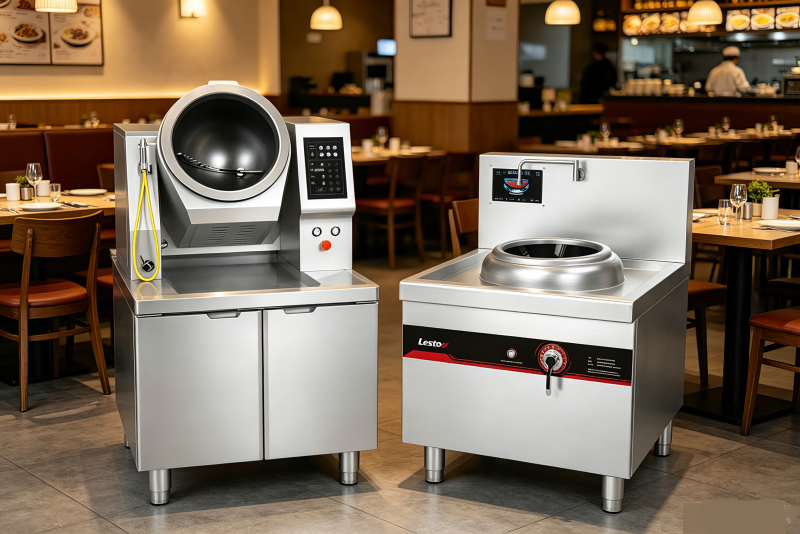
A Chef-Owner’s Deep-Dive Guide to Modern Commercial Kitchen Equipment
Hi everyone, I’m Chef David. Over the past 15 years, I’ve managed high-end Asian fusion restaurants in downtown New York, opened traditional Chinese bistros in London, and expanded a fast-casual wok chain across Western Europe.
If you are a restaurant owner, F&B director, franchise operator, or ghost kitchen developer operating outside of China, you are probably facing the same structural headaches I faced for years: skyrocketing kitchen labor costs, a severe shortage of skilled wok chefs, and strict local fire, environmental, and building codes.
Whenever industry peers visit my restaurants and see my back-of-house (BOH) setups, they almost always ask me the same question: “David, should we stick to traditional cooking with a high-power commercial induction wok range, or should we upgrade to a commercial automatic cooking machine?”
My answer is always the same: It is not a matter of which one is better, but which one fits your specific kitchen workflow and culinary concept. Both are essential, highly specialized tools in modern commercial kitchens. They do not compete with each other; rather, they serve entirely different styles of dining, volume requirements, and business models.
Today, based on my real-world experience across global culinary markets, I am going to share a comprehensive, deep-dive breakdown of how to choose between traditional induction cooking and smart automated kitchen equipment to balance culinary art, operational efficiency, and your bottom line.
I.Why Premium Restaurants Still Rely on Commercial Induction Wok Ranges?
When I opened my upscale Asian bistro, the core concept was “authentic wok hei” (the breath of the wok), exquisite plating, and highly customizable gourmet dishes. For a restaurant where guests pay $80 to $150+ per person, the food cannot taste like it came off an assembly line. It needs the soul, instinct, and touch of a professional artisan culinary artist.
For this kitchen, I equipped our line with top-tier heavy-duty commercial induction wok ranges.
Why High-End Asian and Fusion Restaurants Choose Induction Wok Cookers
In Western cities like New York, London, Paris, and Sydney, traditional open-flame gas wok ranges are becoming increasingly difficult—and expensive—to install. Strict building codes, high insurance premiums for open fires, and the massive HVAC infrastructure required to vent gas exhaust have driven modern chefs toward electric alternatives. This is where the premium commercial induction wok stove becomes a game-changer.
Precision Temperature Control & Instant Heat: Premium induction wok ranges deliver massive wattage (typically ranging from 15kW to 35kW) almost instantly. Unlike gas, which wastes a huge amount of heat energy into the surrounding air, the electromagnetic field heats the wok body directly.
- When a chef adjusts the temperature via a magnetic switch or foot lever, the thermal response is instantaneous. For delicate dishes like tossed seafood, glazed abalone, or velveted chicken, this hyper-responsive control is crucial to prevent overcooking.
- The Mastery of Traditional Wok Hei: A skilled chef stands in front of the induction wok, tossing ingredients high into the air, controlling the reduction of sauces by millisecond adjustments, and infusing that signature smoky, caramelized flavor into every single plate. It allows for absolute customization—whether a VIP guest requests “low sodium,” “extra spicy,” “no MSG,” or a “gluten-free” modification. The chef can adapt the recipe on the fly, mid-toss.
Best Applied Scenarios:
If your establishment is a fine dining restaurant, a boutique private tasting lounge, a gourmet Asian-fusion bistro, or a luxury hotel kitchen where the menu changes seasonally, and culinary artistry is your primary value proposition, the commercial induction wok range is an absolute necessity.
It empowers your professional culinary team to showcase their ultimate skills, manage complex multi-step recipes, and keep food-savvy critics and loyal patrons coming back for an irreplaceable dining experience.
II. Navigating the Global Restaurant Crisis: Why Automatické varné stroje Became Inevitable
While my fine dining bistro thrived, I ran into a massive, frustrating wall when trying to scale a fast-casual Noodle & Rice Bowl concept in major metropolitan transit hubs and high-foot-traffic shopping malls.
Anyone running an Asian restaurant, takeaway shop, or fast-food joint abroad knows the brutal reality of today’s international hospitality market. The traditional model of relying on specialized labor is breaking down due to four main macroeconomic factors:
The Macro Bottlenecks of Modern Foodservice
- The “Wok Chef” Shortage
Finding an experienced wok chef in Western markets who truly understands fire control, tossing techniques, and authentic flavor profiles is like searching for a needle in a haystack. Younger generations of workers simply do not want to stand in front of blistering hot stoves doing heavy physical labor for ten hours a day.
- Exorbitant Labor Costs and Turnover
Because skilled wok chefs are scarce, they command premium salaries that eat away at fast-casual profit margins. Even if you manage to hire a great chef, turnover rates are incredibly high. If your head chef walks out unexpectedly on a busy Friday night, your entire BOH operations can instantly paralyze.
- Inconsistent Food Quality Across Locations
When scaling a brand to 3, 5, or 10 locations, consistency is everything. However, human cooks have good days and bad days. On a chaotic evening rush, Chef A might cook a perfect General Tso’s Chicken, while Chef B might burn the garlic or oversalt the sauce. Inconsistent taste kills repeat business and damages your brand equity.
- Kitchen Safety and Stringent Environmental Inspections
Traditional high-heat open-flame cooking generates massive amounts of ambient heat, airborne grease, and smoke. Meeting strict local EPA, OSHA, and local council HVAC standards can cost tens of thousands of dollars in commercial hood fire-suppression systems and routine maintenance.
I realized that if I wanted to expand my fast-casual brand and launch a network of high-efficiency ghost kitchens, I couldn’t build a business model around scarce, volatile artisan labor.
I needed industrial consistency, speed, and predictability. That was when I reached out to an established, certified commercial automatic cooking machine výrobce and completely revolutionized our fast-casual back-of-house operations.
The Core Advantages of Commercial Stir-Fry Machines
Transitioning to automated kitchen equipment solved our scaling bottlenecks overnight by introducing four core operational advantages:
- 100% Culinary Standardization (SOP)
The machine doesn’t get tired, it doesn’t get distracted by a smartphone, and it doesn’t have emotional mood swings. Once a recipe program is set, whether it is the 1st dish made at 11:00 AM or the 600th dish made during the midnight rush, the cooking time, rotation speed, and temperature curve are perfectly identical. Every single customer gets the same signature taste.
- Massive Reduction in Labor Dependencies
You no longer need a high-salaried wok master on every line. A minimum-wage kitchen porter or a general line cook can be trained to operate 3 to 4 intelligent cooking robots simultaneously after just one afternoon of training. Their job shifts from heavy physical labor to simply loading pre-prepped ingredients into the machine and pressing a button. This effectively cuts your kitchen labor costs by 50% to 70%.
- Incredible Throughput for Delivery & Peak Rush Hours
During lunch hour spikes (12:00 PM – 2:00 PM), when online delivery platforms (like Uber Eats, Deliveroo, Grubhub, or Just Eat) flood your system with dozens of simultaneous orders, these high-efficiency automated stir-fryers can turn out a perfect batch of fried rice, chow mein, or orange chicken in under 3 minutes, ensuring lightning-fast ticket times and zero dropped orders.
- Eco-Friendly, Cooler, and Safer Kitchens
Many modern cooking robots utilize closed or semi-closed rotating drum designs, which drastically reduce grease vaporization and heat dissipation into the room. This keeps your commercial kitchen significantly cooler, lowers air conditioning bills, cuts down hood grease-trap maintenance costs, and easily complies with local municipal health and safety inspections.
Products by Category
-

3500W Commercial Portable Induction Wok Burner LT-TAM-B135
-

3500W stolní restaurační indukční vařič Wok LT-TAM-A135
-

5000W Countertop Restaurant Induction Wok Burner LT-TAM-B505
-

Čínský komerční indukční sporák Wok s jedním hořákem LT-X400
-

Commercial Induction Round Wok Fryer with Omron Thermostatic LT-D700
-

Komerční indukční hořák Wok s velkou pánví LT-X400-D800
-

Double Burners Commercial Induction Wok Cooker with 2 Pots LT-X400II-E108S
-

Double Burners Industrial Induction Wok Stove LT-X400Ⅱ-E108Y
-

Těžký čínský komerční indukční vařič Kadai D800
III. Selecting the Right Automation Toolkit: From Button-Control to Fully Autonomous Systems
When you begin researching solutions from a commercial kitchen equipment supplier, you will quickly realize that the automated cooking category isn’t a one-size-fits-all market. To meet the needs of different kitchen layouts, output volumes, and menu structures, manufacturers have developed a diverse array of models.
Understanding these configurations is essential to designing an optimized workflow. Let’s look at how these machines are segmented:
A. Classification by User Interface & Control System
1. Button-Controlled Commercial Cooking Machine
This is the classic, heavy-duty workhorse of the industry. The control panel consists of rugged, tactile physical buttons, usually paired with a simple digital LED timer.
Why it works: It is built like a tank. Physical buttons are incredibly durable, completely water-resistant, oil-proof, and can withstand the rough, high-pressure environment of a busy kitchen line. For kitchen staff who might not be tech-savvy or who face language barriers, operating a machine via clearly labeled physical buttons (e.g., “Program 1: Fried Rice”) requires absolutely zero learning curve.
2. Touchscreen Smart Cooking Machine
A highly advanced, modern solution featuring a vibrant digital LCD touchscreen interface.
Why it works: It brings smartphone-style convenience to the BOH. It allows kitchen managers to upload actual photos of dishes, input multi-language instructions, and pre-program hundreds of complex, multi-stage recipes. The standout feature here is cloud-based recipe synchronization.
If you operate a growing franchise brand with locations spread across different cities or even different countries, your corporate development chef can tweak a recipe program in the central office, and with one click, push that update to every single touchscreen machine in your global network instantly.
B. Classification by Footprint & Mobility
1. Tabletop / Countertop Cooking Robot
These units are compact, space-saving, and designed to sit neatly on standard stainless-steel prep tables or equipment stands.
Why it works: They are perfect for food trucks, shopping mall kiosks, convenience stores, subway station snack bars, and micro ghost kitchens where every square inch of counter space is at an absolute premium. They usually run on standard commercial power connections, feature easy plug-and-play setups, and can be moved or rearranged with minimal effort.
2. Vertical / Freestanding Cooking Machine
Heavy-duty, high-capacity standalone units built on their own integrated wheeled chassis or solid legs, featuring large-diameter rotating drums.
Why it works: These are designed for massive, continuous food production. They are the ideal choice for high-volume catering operations, school cafeterias, corporate dining halls, military bases, and central production kitchens (CPKs). A single large vertical machine can produce dozens of portions of food in a single cycle, making quick work of mass feeding requirements.
C. Classification by Automation Depth (The Operational Logic)
This is the most critical technical distinction you will make, as it dictates your entire BOH ingredient prep and assembly line logic:
1. Semi-Automatic Cooking Machine (Manual Ingredient & Sauce Feeding)
In this setup, the machine handles the exhausting physical labor—precise induction heating, exact timing, automated drum rotation speed, and mechanized tilting/pouring. However, the human operator remains part of the process.
The machine will run its program, and when it reaches a specific step (e.g., time to add sauce or delicate vegetables), it will emit an audible beep or flash a visual cue on the screen. The operator then manually dumps the pre-portioned ingredients or liquid sauces into the rotating drum.
Best Applied Scenarios: This is ideal for concepts that want to maintain a level of “human oversight” or cook menus with delicate textures. For instance, if you are frying tender leafy greens, adding soft tofu, or doing a precise cornstarch slurry thickening at the very end of a dish, the semi-automatic model allows the worker to visually check the food before advancing the program. It offers an exceptional balance of mechanical efficiency and human culinary control at a highly competitive entry-level price point.
2. Fully Automatic Cooking Machine (Autonomous Ingredient & Seasoning Dispensing)
This represents the pinnacle of commercial kitchen robotics. These machines are completely self-contained, autonomous cooking cells. They are engineered with integrated, multi-channel liquid and powder storage tanks (connected to precise peristaltic pumps that measure out oil, soy sauce, vinegar, water, salt, sugar, and starch solutions) alongside a multi-tiered mechanical ingredient hopper or conveyor tray system.
The operational workflow is entirely hands-off: at the start of the shift or order cycle, the prep worker places the raw proteins, aromatics, and vegetables into separate designated slots on the loading tray and fills the seasoning reservoirs. The operator selects the dish on the panel and walks away to do other tasks.
The robot’s internal computer takes complete control: it heats the drum to the exact target temperature, injects the cooking oil, drops the meat at minute 1:00, adjusts the rotation speed, drops the vegetables at minute 2:30, injects exactly 3 grams of salt and 5 milliliters of soy sauce at minute 3:15, performs a high-speed sear, and automatically tilts the drum to slide the finished meal perfectly into a serving bowl.
Best Applied Scenarios: This system is designed for zero-chef kitchens, high-volume, delivery-only ghost-kitchen hubs, highly standardized national fast-food chains, and automated express-dining concepts. It turns food production into a highly predictable, factory-like assembly process, maximizing profit margins and ensuring absolute operational scalability.
IV. The Ultimate Selection Formula: Matching Equipment to Your Business Model
To help you clearly visualize where each piece of equipment belongs in a modern commercial kitchen layout, let’s examine this comprehensive reference matrix across key operational metrics:
| Multi-tasking execution; a single operator can run 3-4 machines continuously | Komerční indukční řada Wok | Commercial Automatic Cooking Machine |
| Primary Value Proposition | Artisan craftsmanship, authentic wok hei, infinite culinary customization | Absolute consistency, massive labor savings, high-volume rapid throughput |
| Control Interface | Manual knee/lever slider or magnetic manual switch | Digital Button Control / Smart Touchscreen / Cloud Recipe Sync |
| Automation Level | 100% Manual (Requires skilled chef) | Semi-Auto (Manual Feeding) / Fully Auto (Robotic Dispensing) |
| Form Factor & Options | Standard standalone single/double wok stations or built-in line configurations | Tabletop (Compact, mobile) / Vertical (High Capacity Freestanding) |
| Labor Requirement | High-salaried, certified professional wok chef | Low-cost general kitchen porter or line operator |
| Throughput Characteristics | Single-order execution; highly dependent on chef speed and stamina | Multi-tasking execution; single operator can run 3-4 machines continuously |
| Ideal Food Business Type | Fine Dining, Gourmet Bistros, Hotel Restaurants, Traditional Asian Heritage Eateries | Multi-tasking execution; a single operator can run 3-4 machines continuously |
Strategic Purchasing Decision Guide:
To make your equipment procurement process simple, use this three-part decision formula based on your restaurant’s core identity:
- Analyze Your Average Ticket Size & Guest Expectations
If your concept relies on premium menu pricing where customers expect customized options, artistic plating, and complex textures, you should invest in high-efficiency commercial induction wok ranges. Focus your capital on hiring top-tier culinary talent and pairing them with highly responsive, powerful induction wok stoves that allow them to practice their craft safely and efficiently without open flames.
- Analyze Your Scaling & Expansion Strategy
If you are aiming to build a scalable brand with plans to open 5, 20, or 50 locations serving fast-casual bowls, fried rice, stir-fried noodles, or curries under $15 per plate, you cannot afford to rely on artisan labor.
Work directly with an experienced manufacturer of commercial automatic cooking machines. Implement a combination of tabletop or vertical units to build a highly optimized, easily repeatable BOH pipeline that can be managed by basic hourly staff anywhere in the world.
- Analyze Your Menu Dynamics & Customization Needs
For a diverse menu requiring delicate cooking techniques or frequent seasonal changes, opt for semi-automatic cooking machines to gain mechanical efficiency while retaining human oversight. For high-volume, single-item focused menus (such as specialized fried rice shops, express teriyaki concepts, or high-volume noodle boxes), implement fully automatic cooking robots to drive down operational overhead to the absolute minimum.
Products by Category
-

Automatic Cooking 6 Burners Commercial Induction Cooker LT-B300VI-E235
-

Automatic Food Stir-Fryer Wok Machine-LT-CD300L-A105
-

Automatic Robotic Wok Cooking Machine for Restaurant Canteen LT-CD300-B205
-

Pultový automatický stroj na smaženou rýži -LT-TGD36
-

Countertop Commercial Gas Automatic Fried Rice Machine LT-TGD36R
-

Countertop Robot Wok Cooker with Touch Screen LT-TGQ30J
-

Countertop Rotating Stir-Fry Machine for Restaurant LT–TGD30
-

Heavy-duty Automatic Stir-Fryer for Commercial Kitchen LT-GD36
-

Industrial Heavy-duty Automatic Stir Cooking Machine LT-CD600T4-D130
V. Conclusion: Empowering the Future of Global Hospitality
In my current international restaurant portfolio, I don’t choose between these two technologies—I proudly use both. In my high-end downtown fusion bistro, a row of sleek, heavy-duty commercial induction wok ranges allows my culinary team to craft award-winning dishes that draw crowds every weekend.
Meanwhile, at my five fast-casual delivery hubs located near major university campuses and business districts, lines of fully automatic touchscreen cooking machines work tirelessly, pumping out thousands of consistent, delicious, budget-friendly meals every single week with minimal staff overhead.
The future of global hospitality isn’t about technology replacing tradition; it’s about leveraging technology to protect, stabilize, and optimize your specific business model.
As a restaurant owner or F&B executive, don’t let outdated kitchen conventions limit your growth, and don’t let current labor shortages or rising wages threaten to shut down your expansion plans. Take a close look at your brand’s identity, calculate your throughput requirements versus your labor metrics, and deploy the right tool for the right kitchen line.
If you are currently setting up a new restaurant location overseas, designing a high-capacity ghost kitchen layout, or upgrading an existing commercial kitchen to meet modern labor, safety, and environmental challenges, let’s collaborate.
Leave a comment below or contact us directly as your premier commercial kitchen equipment manufacturer. We specialize in export-ready, internationally certified induction cookers and intelligent cooking automation systems tailored to global voltages, regional safety compliance, and diverse culinary traditions. Let us help you design a highly profitable, future-proof commercial kitchen today!
About Lestov Manufacturer
We are a leading global OEM/ODM manufacturer and exporter of commercial kitchen solutions. Our premium product lines feature heavy-duty commercial induction wok ranges, smart tabletop cooking robots, vertical high-capacity stir-fry machines, and fully automated multi-ingredient cooking systems.
All products comply with international electrical and safety standards (CE configurations available). Contact our export division today for factory-direct commercial automatic cooking machine prices, technical specifications, and customized kitchen layout consultations!
automatický stroj na vaření automatické varné stroje bbq chip fryer commercial cooking equipment commercial drop in induction cooker commercial food steamer commercial induction cooker commercial induction cooktop komerční indukční fritéza commercial induction fryer commercial induction griddle commercial induction hob commercial induction soup cooker Komerční indukční parní vařič commercial induction wok cooker komerční kuchyně cookware food steamer hob indukční vařič induction cookware INDUCTION FRYER induction grill induction hob iron wok kitchen equipment repair guide restaurangt equipment restaurant equipment stainless steel cookware user's guidance
Související příspěvky


Comments (0)