
My name is David Vance, and I am the Co-Founder and Operational Director of Lotus…
.jpg)
How an All-Electric Line Crushes Peak-Hour Kitchen Bottlenecks
Ask any fast-casual operator or ghost kitchen manager in London, New York, or Sydney about their single biggest operational nightmare, and they will all give you the same answer: The 12:00 PM to 1:30 PM Order Tsunami.
During peak dining hours, customer tickets, Third-Party Delivery orders (Uber Eats, DoorDash, Deliveroo), and drive-thru requests all hit the Back-of-House (BOH) simultaneously. If your kitchen line stalls for even two minutes, a deadly ripple effect begins:
- Ticket times spike from 5 minutes to 25 minutes.
- Delivery drivers overcrowd the pickup counter.
- Frustrated customers cancel orders, leaving you with negative online reviews and algorithm penalties on delivery platforms.
Traditional gas lines simply cannot scale instantly under this extreme pressure. Gas flat-tops suffer massive thermal recovery drops when loaded with cold meat, and manual wok chefs can only toss one pan at a time.
To survive and profit from peak-hour velocity, modern operators are deploying a multi-threaded, all-electric production workflow. By integrating three ultra-fast electric assets a high-output commercial induction griddle, an intelligent commercial automatic cooking machine, and a high-power commercial induction wok range you turn your kitchen into an unbreakable, high-throughput food factory.
PEAK-HOUR PARALLEL PROCESSING LINE
- Induction Griddle: Continuous Protein – Searing Engine
- Smart Cooking Robots: Automated Rice/Noodle – High-Volume Base Engine
- Induction Wok: Rapid Sauce – Glazing Engine
- Minute Lightning Ticket Completion
1. Zero Thermal Lag: How the Commercial Induction Griddle Eliminates Flat-Top Bottlenecks
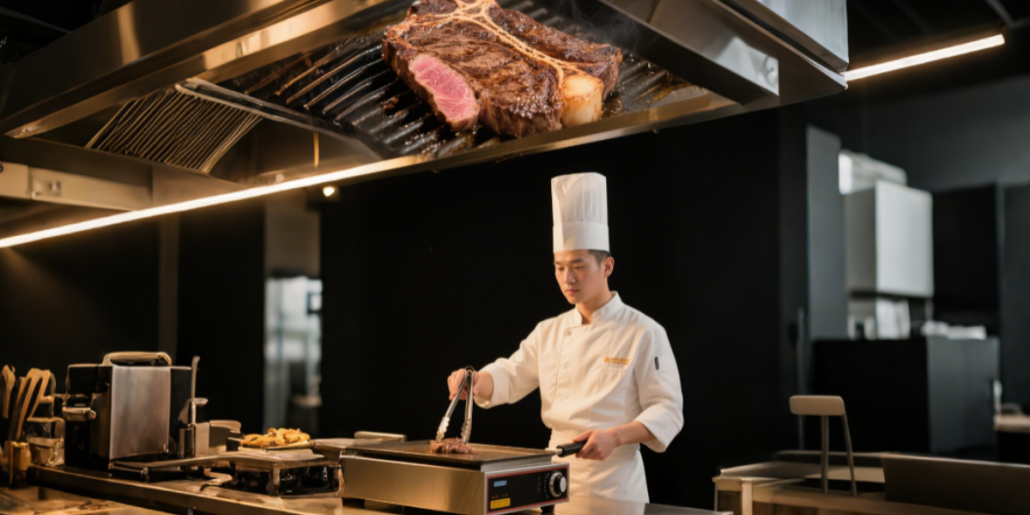
During a rush, the flat-top surface is usually the first major bottleneck in a Western or fusion kitchen. On a traditional gas griddle, when a line cook drops 25 cold, raw hamburger patties or rows of steak strips across the plate, the surface temperature plunges. The meat begins to simmer in its own moisture instead of searing, adding 3 to 5 extra minutes per batch.
The Thermal Physics of Instant Heat Recovery
Upgrading to a high-performance commercial electric flat top griddle built with advanced induction technology solves this physics challenge completely:
· Instant Thermal Recovery
Induction technology heats the heavy-gauge steel or chrome griddle plate directly through magnetic energy, rather than relying on inefficient gas flame conduction. When cold proteins hit the surface, internal sensors trigger an immediate, targeted wattage boost.
The plate maintains a steady 230°C (450°F) without breaking a sweat, ensuring instant sear marks, perfect caramelization, and consistent cooking times ticket after ticket.
· Multi-Zone Concurrent Cooking
A heavy-duty commercial electric griddle allows cooks to manage multiple order types concurrently. While Zone A is for flash-searing smash burgers or chicken breasts at maximum heat, Zone B is for gently warming tortillas or buns, and Zone C is for holding finished proteins at safe serving temperatures. No wasted space, no wasted time.
TRADITIONAL GAS vs. INDUCTION GRIDDLE RUSH PERFORMANCE
- Gas Griddle: Cold Meat Load -> Temp Drops -> Meat Stews
- Induction Griddle: Cold Meat Load -> Auto Wattage Boost -> Sear!
2. Mass Parallel Processing: Deploying Commercial Automatic Cooking Machines for Bulk Bases
While your grill cook is searing protein on the commercial induction griddle, what happens to the massive volume of fried rice, chow mein, or sautéed vegetables needed for lunch bowls and combo meals?
In a traditional setup, a chef standing over a manual wok is a single-threaded processor—they can only cook one dish at a time. When 30 orders of fried rice hit the screen, a manual chef becomes an instant bottleneck.
Decoupling Volume from Human Limitations
By sourcing equipment directly from a certified commercial automatic cooking machine manufacturer, operators can transform single-threaded manual lines into multi-threaded automated cells:
· Simultaneous Multi-Batch Production
A single operator can oversee a bank of three tabletop/countertop cooking machines or two large freestanding vertical cooking machines. While Machine 1 automatically flips a 15-portion batch of signature egg fried rice, Machine 2 is stir-frying garlic noodles, and Machine 3 is simmering a rich curry sauce.
· 100% SOP Consistency Under Stress
Human cooks under extreme stress make mistakes—they rush, skip seasoning steps, or burn ingredients. An intelligent cooking robot with touchscreen preset recipes executes the same thermal curve and timed rotation every single time, ensuring that the 100th dish during a hectic lunch rush tastes identical to the 1st dish of the morning.
SINGLE-THREADED vs. MULTI-THREADED BOH
- 1 Manual Chef = 1 Wok = 1 Dish Every 4 Minutes
- 1 Operator + 3 Cooking Robots = 3 Bulk Dishes Every 3 Minutes
Products by Category
-

Automatic Cooking 6 Burners Commercial Induction Cooker LT-B300VI-E235
-

Automatic Food Stir-Fryer Wok Machine-LT-CD300L-A105
-

Automatic Robotic Wok Cooking Machine for Restaurant Canteen LT-CD300-B205
-

Commercial Gas Automatic Wok Machine Intelligent Stir Fryer LT-TGS30R
-

Countertop Commercial Automatic Fried Rice Machine -LT-TGD36
-

Countertop Commercial Gas Automatic Fried Rice Machine LT-TGD36R
-

Countertop Robot Wok Cooker with Touch Screen LT-TGQ30J
-

Countertop Rotating Stir-Fry Machine for Restaurant LT–TGD30
-

Heavy-duty Automatic Stir-Fryer for Commercial Kitchen LT-GD36
3. The Blitz Finisher: The Role of the Commercial Induction Wok Range in Rapid Glazing
With the commercial induction griddle handling mass protein searing and the commercial automatic cooking machine mass-producing consistent rice and noodle bases, where does the manual commercial induction wok range fit into a high-speed rush line?
It becomes the ultimate “Blitz Finisher” station for customized, high-margin, made-to-order dishes.
The 30-Second Finishing Workflow
In an optimized peak-hour assembly line, the heavy-duty induction wok station is used exclusively for rapid sauce reduction and high-heat finishing:
· Base Transfer
A line cook scoops a portion of pre-cooked, hot rice or noodles from the automated cooker line into the concave induction wok bowl.
· Protein Addition
Perfectly seared steak, chicken, or shrimp is transferred directly from the nearby induction griddle.
· High-Heat Flash Finish
The cook activates the 15kW–35kW induction wok stove using an intuitive knee-lever. Instant, concentrated heat coats the ingredients in house sauce and infuses authentic wok hei in under 30 seconds.
Because an induction wok range requires zero preheating time—delivering maximum thermal energy the exact millisecond the pan touches the bowl—there is zero energy wasted during idle periods between tickets.
Products by Category
-

3500W Commercial Portable Induction Wok Burner LT-TAM-B135
-

3500W Tabletop Restaurant Induction Wok Stove LT-TAM-A135
-

5000W Countertop Restaurant Induction Wok Burner LT-TAM-B505
-

Chinese Commercial Single Burner Induction Wok Stove LT-X400
-

Commercial Induction Round Wok Fryer with Omron Thermostatic LT-D700
-

Commercial Induction Wok Burner With Large Frying Pan LT-X400-D800
-

Double Burners Commercial Induction Wok Cooker with 2 Pots LT-X400II-E108S
-

Double Burners Industrial Induction Wok Stove LT-X400Ⅱ-E108Y
-

Heavy-Duty Chinese Commercial Induction Kadai Cooker D800
4. Designing the Ultimate Rush-Ready Kitchen Assembly Layout
To achieve maximum throughput, you must configure these three core equipment assets into a seamless, ergonomic physical layout. Working with a versatile commercial kitchen equipment manufacturer allows you to build a modular setup tailored to your physical footprint:
THE ULTIMATE RUSH-READY WORKFLOW
STEP 1: PROTEIN SEARING
STEP 2: BASE PRODUCTION
Commercial Induction Griddle -> Smart Automatic Cooking Robot
STEP 3: BLITZ SAUCE FINISH
Commercial Induction Wok Stove
STEP 4: PACKAGING / PLATING
Pass-Through Expo Station
Layout Configuration Strategies:
- The Compact Express Line (For Ghost Kitchens & Mall Kiosks): Place a countertop commercial electric griddle, a tabletop automatic cooking machine, and a single-burner tabletop induction wok range side-by-side on a stainless steel worktable. This creates a hyper-efficient 2-person workstation capable of generating over 120 custom meal bowls per hour.
- The High-Volume Franchise Line (For QSR Chains & Food Halls): Position a double-zone freestanding commercial induction griddle next to a battery of three vertical freestanding automatic cooking machines, anchored by a twin-burner commercial induction wok range. This industrial configuration allows a 3-person line crew to feed hundreds of hungry patrons during peak hours with zero fatigue and zero ticket lag.
5. Peak-Hour Performance Comparison Matrix
To help franchise developers, operations directors, and restaurant owners quantify the throughput gains of an all-electric line during peak rush hours, this matrix compares traditional lines with the modernized electric triad:
| Performance Metric | Traditional Gas & Manual Line | Modern All-Electric Triad Line |
| Griddle Heat Recovery | Slow (Plate temperature drops, causing protein stewing) | Instant (Induction maintains exact temperature under heavy load) |
| Base Item Batch Output | Limited (1 chef = 1 manual pan at a time) | Exponential (1 operator manages 3+ automated cooking drums) |
| Preheating Time Required | 20–30 minutes before rush (Wasted gas energy) | 0 seconds (Instant-on induction electromagnetic heat) |
| Average Ticket Lead Time | 12 – 18 minutes during peak rush | 3 – 5 minutes during peak rush |
| Staff Stress & Error Rate | Extremely high (Frequent missed ingredients, burnt food) | Minimal (Preset SOPs handle temperature and timing automatically) |
| Order Throughput Capacity | ~40 – 60 meals per hour per cook | ~120 – 180 meals per hour per operator |
6. Conclusion: Turning Kitchen Velocity into Bottom-Line Profit
In the modern restaurant industry, speed is no longer just a service metric—it is the ultimate driver of profitability. Every extra minute a ticket sits on your screen during a rush is money left on the table. Every order delayed is a lost customer who won’t order from your brand again.
By replacing slow, thermal-lagging gas equipment with a synchronized electric triad—combining the heavy-duty surface power of a commercial induction griddle, the automated volume of a commercial automatic cooking machine, and the flash-finishing speed of a commercial induction wok range—you eliminate kitchen bottlenecks once and for all.
Don’t let peak-hour rushes overwhelm your staff or limit your revenue. Upgrade your BOH workflow to an ultra-fast, high-throughput production engine.
If you are an international restaurant chain owner, a ghost kitchen operator, or a franchise developer looking to optimize your ticket times, let’s collaborate.
Leave a comment below or contact us directly- your premier commercial kitchen equipment manufacturer. We provide factory-direct, globally certified induction griddles, commercial wok ranges, and smart cooking automation systems built to meet international voltage and safety standards. Contact our team today to request a custom throughput analysis, equipment pricing, and kitchen layout design for your business!
automatic cooking machine automatic cooking machines bbq chip fryer commercial cooking equipment commercial drop in induction cooker commercial food steamer commercial induction cooker commercial induction cooktop commercial induction deep fryer commercial induction fryer commercial induction hob commercial induction soup cooker Commercial Induction Steamer Cooker commercial induction wok cooker commercial kitchen cookware food steamer hob induction cooker induction cookware INDUCTION FRYER induction grill induction hob iron wok kitchen equipment repair guide restaurangt equipment restaurant equipment stainless steel cookware user's guidance
Related Posts


Comments (0)